Strategic readiness for leadership teams
When strategic goals keep falling short, look beneath the plan.
maturityOS shows your leadership team where execution is breaking down, aligns everyone around the same organizational reality, and turns that clarity into a sequenced roadmap with clear owners, goals, and measurable progress.
Diagnose misalignment. Prioritize what matters. Keep execution in sync.










The problem
You may not need another plan. You may need a clearer operating picture.
Your strategy is defined. The leadership team has agreed on the priorities. Goals have been assigned. But execution still drifts.
Departments interpret the strategy differently. Leadership meetings revisit the same debates. Initiatives compete for attention. Dashboards show activity without explaining why progress is stalling.
The problem is often not a lack of ambition or effort. It is that the organization underneath the strategy is not equally prepared to execute it.
Recognizable symptoms
Does this sound familiar?
- Strategic priorities lose momentum once they reach the business.
- Leaders agree in the meeting but execute in different directions.
- Objectives exist, but ownership and accountability remain unclear.
- New initiatives launch without resolving the constraints beneath them.
- You have plenty of data but limited visibility into what needs attention next.
- Every planning cycle begins by reconsidering the same unresolved issues.
maturityOS helps your leadership team identify the conditions producing those outcomes.
The core idea
Most teams plan from where they hope to be.
Effective strategy begins with an honest, shared picture of where the organization is today.
maturityOS independently evaluates how leaders perceive the organization across culture, capability, and continuity. It makes agreement and disagreement visible, helps the team reconcile those differences, and creates one evidence-based operating picture.
The result is not another assessment score. It is a shared foundation for better decisions.
What maturity means
Maturity is not a grade.
It is a measure of how reliably your organization can execute what the strategy requires.
An organization can be financially successful and still lack the leadership alignment, processes, information, people, or operating resilience required for its next strategic move.
Where you are
One system that meets you where you are.
Establish reality before writing the plan.
You are entering a first strategic cycle, onboarding new leadership, integrating an acquisition, or redefining the business after a major change. maturityOS helps you establish an evidence-based baseline before priorities and investments are finalized.
Connect the plan to the organization underneath it.
You already use goals, OKRs, scorecards, or quarterly reviews, but performance remains uneven and organizational friction is difficult to explain. maturityOS shows whether the business has the capabilities required to deliver the plan.
Diagnose the gap before another replan.
You executed the strategy, but it did not produce the expected results. Restructuring, new systems, or additional initiatives have not resolved the underlying problem. maturityOS helps your leadership team identify what is actually preventing progress before you rewrite the plan again.
What changes
Move from strategic intent to coordinated execution.
See reality together
Surface where leaders agree, where their perceptions diverge, and what those differences reveal about the organization.
Know what to address next
Identify the maturity constraints most relevant to the strategy and the dependencies between them.
Sequence the work
Turn broad concerns into a limited number of prioritized initiatives with clear owners, measures, and checkpoints.
Keep leadership in sync
Use scorecards and regular reviews to maintain visibility, resolve blockers, and adjust as organizational conditions change.
The system
One system. The full strategic cycle.
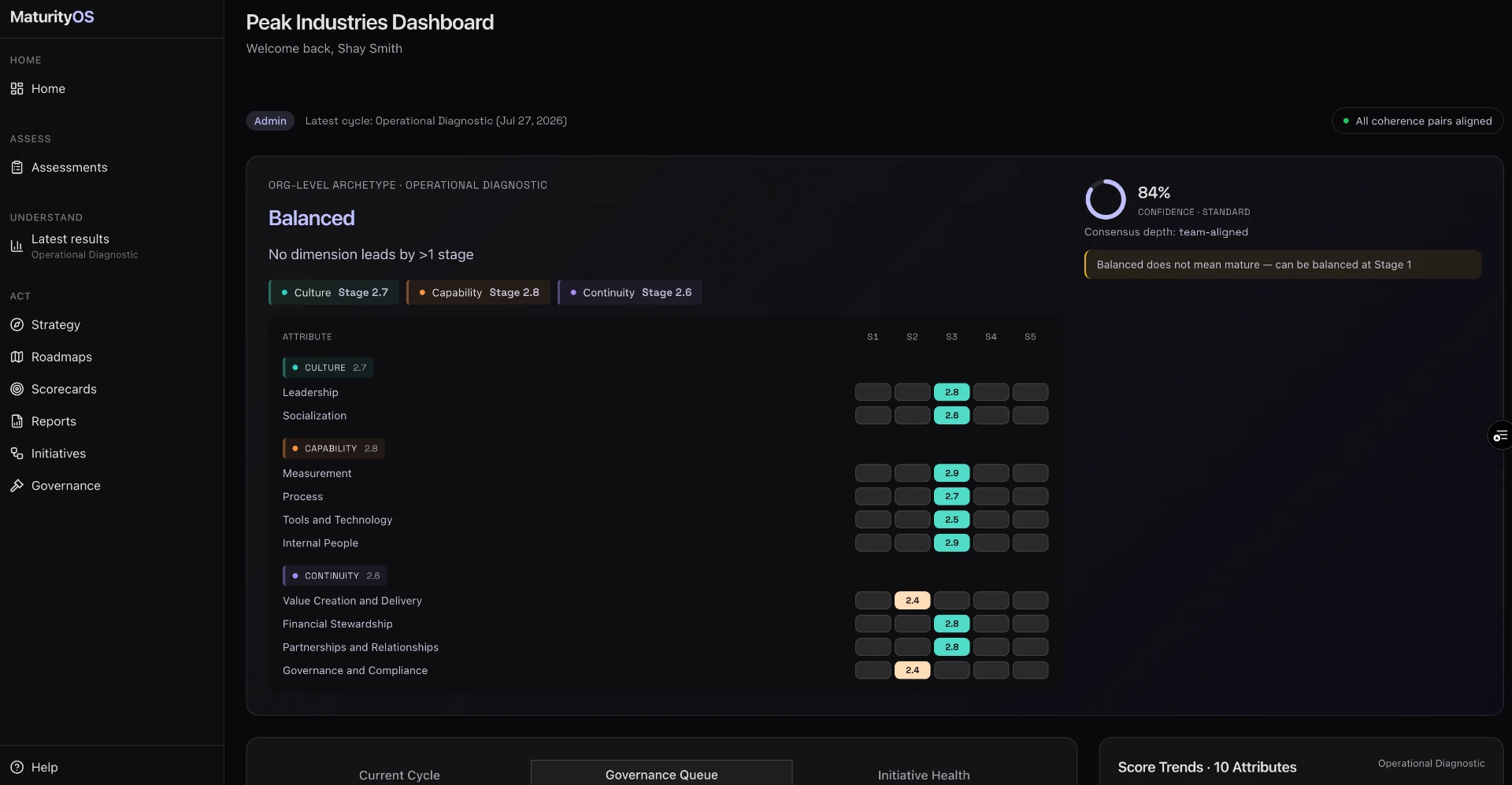
Diagnostic
Build a multi-perspective view of the organization across culture, capability, and continuity. See not only the maturity level of each area, but where your leadership team holds materially different views of current reality.
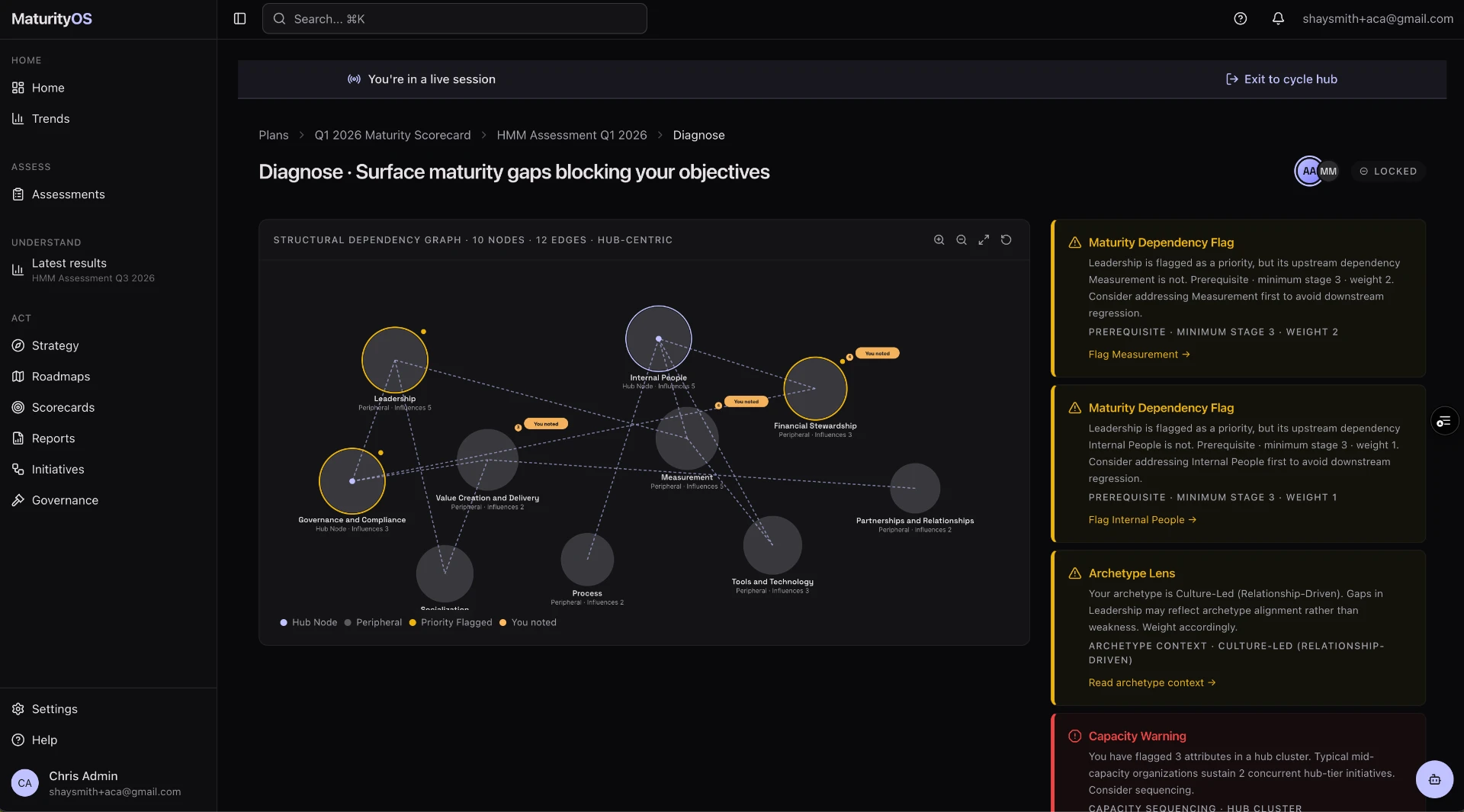
Roadmap
Translate assessment findings into sequenced strategic priorities, initiatives, goals, and ownership. Address the capabilities that make execution possible, not the symptoms that appear when execution fails.
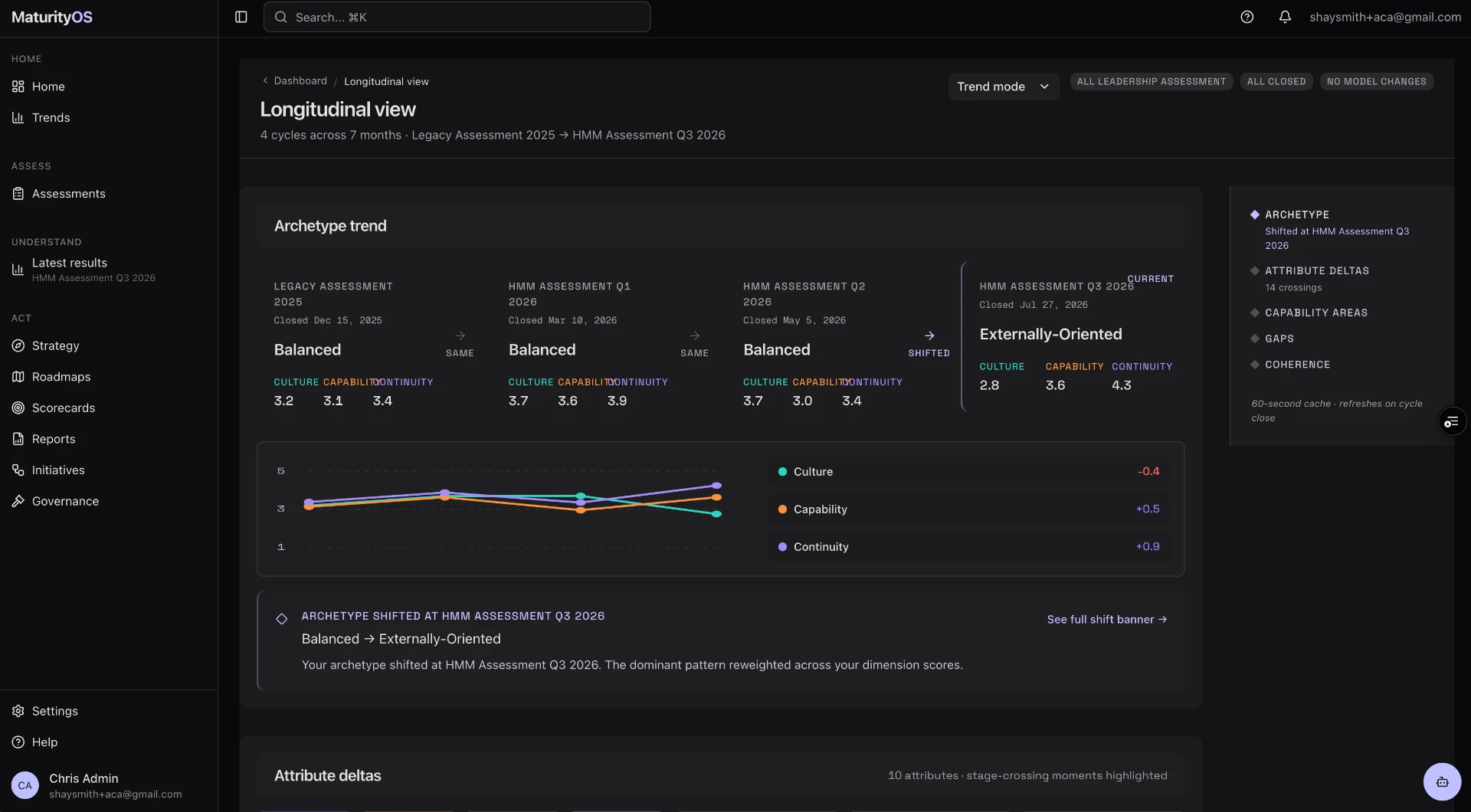
Scorecards
Connect objectives and measures to the underlying maturity areas they are intended to develop. Strategic management becomes an operating discipline rather than an annual event.
What you leave with
Clarity your leadership team can operate from.
- One shared picture of organizational reality.
- Clear visibility into the constraints affecting strategic execution.
- A limited set of high-leverage priorities.
- Sequenced initiatives with named owners.
- Measures that show whether underlying capability is improving.
- A review cadence that keeps the strategy connected to the business.
The model
Rigorous underneath. Clear at the executive level.
The Holistic Maturity Model evaluates the organization through three connected dimensions. Ten organizational attributes and 64 sub-attributes are scored to a behavior-based, five-stage maturity scale, so progression is measured, not asserted.
The depth lives beneath the surface. Leaders receive a clear operating picture and a practical path forward.
How leadership, communication, expectations, accountability, and shared norms influence coordinated action.
How people, processes, measurement, and technology enable reliable execution.
How the organization creates value, manages resources, builds relationships, governs risk, and prepares for sustained growth.
Differentiation
Not another dashboard. Not another static strategy deck.
Goal & OKR software
Tracks progress against goals that have already been selected. Rarely determines whether the organization has the underlying capability to achieve them.
Traditional consulting
Provides a valuable point-in-time diagnosis and strategic plan, but the insight often stays trapped in a presentation and disconnected from the next operating cycle.
maturityOS
Connects organizational diagnosis, strategic priorities, initiatives, goals, and scorecards to one shared maturity baseline. Leadership sees not only whether execution is progressing, but what is making progress possible, or preventing it.
Proof
See what your team cannot see alone.
“We knew things needed to change, but our efforts were not solving the real problem. maturityOS helped us see what we couldn’t.”
Stop beginning every planning cycle with the same unanswered questions.
Establish a shared picture of your organization, identify what is preventing execution, and give your leadership team a visible path forward.
FAQ
Common questions.
Who is maturityOS for?
CEOs, presidents, COOs, executive teams, and strategic advisors leading organizations through growth, transformation, restructuring, or repeated execution challenges.
Is this another goal or OKR tool?
No. Goal tools measure progress against objectives. maturityOS evaluates and develops the organizational capabilities that determine whether those objectives can be achieved reliably. Goals, initiatives, and OKRs can then be managed against that maturity baseline.
Does a lower maturity level mean our organization is performing poorly?
No. Maturity is not a judgment of business quality or financial performance. It describes how developed and dependable a particular organizational capability is relative to what the strategy requires.
What does the leadership team receive?
A shared maturity baseline, visibility into leadership alignment and disagreement, prioritized development areas, a sequenced roadmap, assigned initiatives, and scorecards for measuring progression.